StoriesMATERIAL
Birch, steel, and nothing else
Two materials, one finish process, and a short list of things we decided not to use. The palette is a constraint that keeps the system honest.
January 20264 min
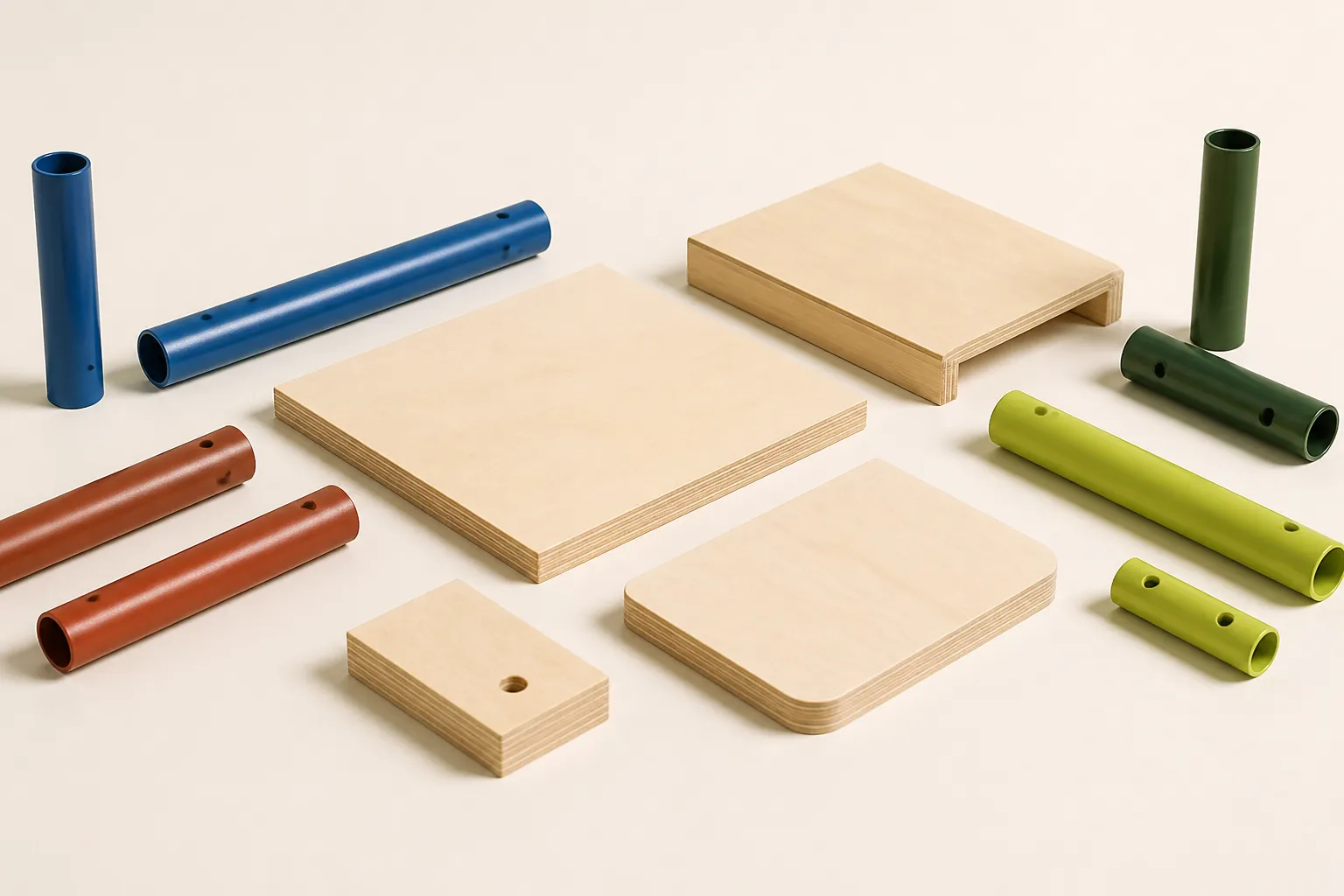
The whole system is birch plywood and powder-coated steel tube. That is the list. There is no veneered particle board anywhere in it, no plastic corner blocks, and no cam locks, because those three are the parts that decide when flat-pack furniture dies.
Plywood is used with its edge showing. The layered edge is the honest face of the material and it is also the strongest one, so the joints are cut where the plies run across the load rather than with it. A sanded and oiled edge takes knocks in a way a wrapped edge cannot: it marks, and then it stops looking new, and then it stays exactly like that.
The steel is square tube rather than round because square meets plywood along a line instead of a point, and because a square upright tells you which way it is facing. Powder coat goes on after the slots are cut, so the cut edges are covered rather than exposed. The four colours in the system — cobalt, rust, deep green and lime — are chosen to sit against birch without either one winning.
What we left out matters as much. No glue in any joint a customer touches, because glue makes a move permanent. No proprietary fastener, because a proprietary fastener is a part you cannot replace. And no finish that hides the material underneath, because in four years you should still be able to see what you bought.